
Opal, with its captivating play-of-colour, has fascinated humanity for centuries. This unique gemstone, a hydrated amorphous form of silica, captures and refracts light to create a dazzling internal spectrum, making each stone a miniature universe of vibrant hues. While Australia is famously known for producing the majority of the world’s precious opal, this enchanting mineraloid can be found in diverse locations across the globe, each offering its own distinctive varieties.
The Geological Story of Opal Formation
At its core, opal is a form of hydrated amorphous silica (SiO2⋅nH2O), meaning it’s composed of silicon dioxide and water, without a fixed crystalline structure like quartz and other crystals and minerals. So technically speaking, opal is NOT crystal or mineral, IS A mineraloid. The formation of opal is a slow and intricate geological process:
- Silica-Rich Water: It begins with silica-rich water percolating through the Earth’s crust, often in arid or semi-arid regions. This water dissolves silica from decomposing rocks, such as sandstone or volcanic ash.
- Deposition: As this silica-laden solution seeps into cracks, fissures, and cavities within rocks, or even into fossilized organic matter (like wood or shells), the water gradually evaporates.
- Silica Gel: The evaporating water leaves behind a silica-rich gel, which slowly hardens over millions of years.
- Precious vs. Common Opal: The magic of precious opal lies in the microscopic, uniform spheres of silica that arrange themselves in a regular, three-dimensional grid. This ordered structure diffracts light, creating the characteristic “play-of-colour.” In contrast, common opal (also known as potch) has a disordered internal structure of silica spheres, or spheres of varying sizes, which prevents light diffraction, hence no play-of-colour.
- Environments: This formation process explains why opals are found in various geological settings:
- Sedimentary Basins: The vast Australian opal fields are prime examples, where silica solutions filled cracks and voids in ancient sedimentary rocks.
- Volcanic Rock: Opals from Mexico and Ethiopia often form in volcanic environments, where silica-rich volcanic ash and flows provide the necessary conditions.
A Global Tapestry of Opals
From the fiery depths of Mexico to the ancient grounds of Ethiopia and the vast landscapes of Australia, opals manifest in an astonishing array of types, each with unique characteristics and origins:
- Australian Opals: Australia is the undisputed capital of precious opal, accounting for an estimated 95% of the world’s supply.
- Black Opal: Revered for its dark body tone that dramatically enhances the play-of-colour, black opals from Lightning Ridge, New South Wales, are among the most valuable.
- White/Light Opal: Predominantly found in Coober Pedy, South Australia, these opals have a light body tone, ranging from translucent to opaque white, often displaying soft pastel flashes.
- Boulder Opal: Unique to Queensland, these opals form within ironstone boulders, with the host rock often left as part of the gem, creating striking patterns and a natural backing that intensifies the opal’s colour.
- Crystal Opal: Characterized by its transparent or translucent body, crystal opals allow light to pass through, creating a brilliant and often more intense display of internal fire. They are found in various Australian fields, including Coober Pedy and Lightning Ridge.
- Matrix Opal: This type features a fine network of opal within its host rock, often ironstone, found in areas like Queensland and Andamooka, South Australia.
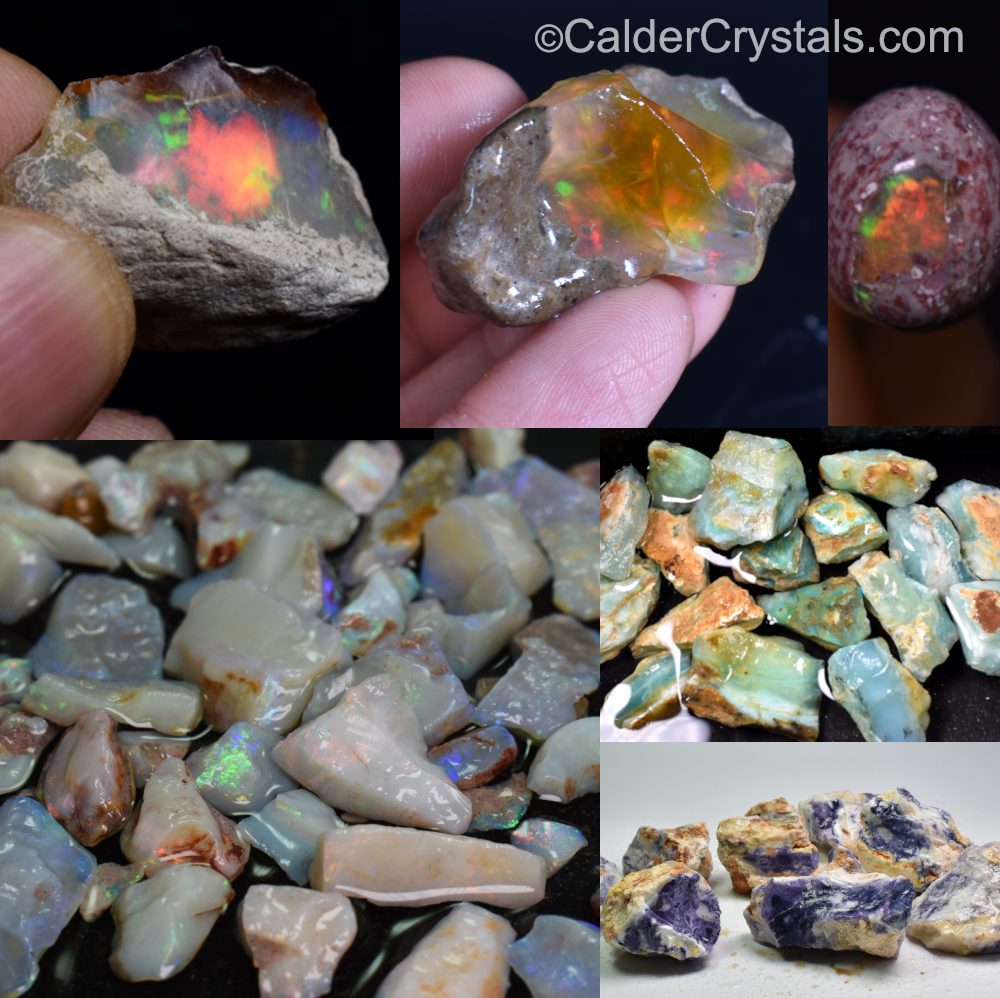
- At Calder Crystals, We are proud to feature Australian opals from Lightning Ridge, Coober Pedy, Mintabie and Queensland, please check the link for details Australian Opals
- Mexican Opals: Mexico is renowned for its vibrant “fire opals,” characterized by their warm body colours ranging from yellow and orange to fiery red. These opals may or may not display a play-of-colour. Beyond fire opals, Mexico also offers unique varieties such as:
- Morado Opal (Mexican Purple Opal/Violet Flame Opal/Opal Royale): A common opal recently discovered in Durango, Mexico, Morado Opal is known for its beautiful purple hues. While it doesn’t exhibit the traditional play-of-colour, its rich colour, often resulting from a composition similar to Tiffany stone (opal and fluorite), makes it highly sought after.
- Mexican Galaxy Opal: This variety suggests a mesmerizing appearance, often with patterns that evoke cosmic imagery.
- At Calder Crystals, you can find Morado opal, Galaxy opal and Hyalite Opal please check the link for details Mexican Opals
- Ethiopian Opals: Emerging as a significant source in recent decades.
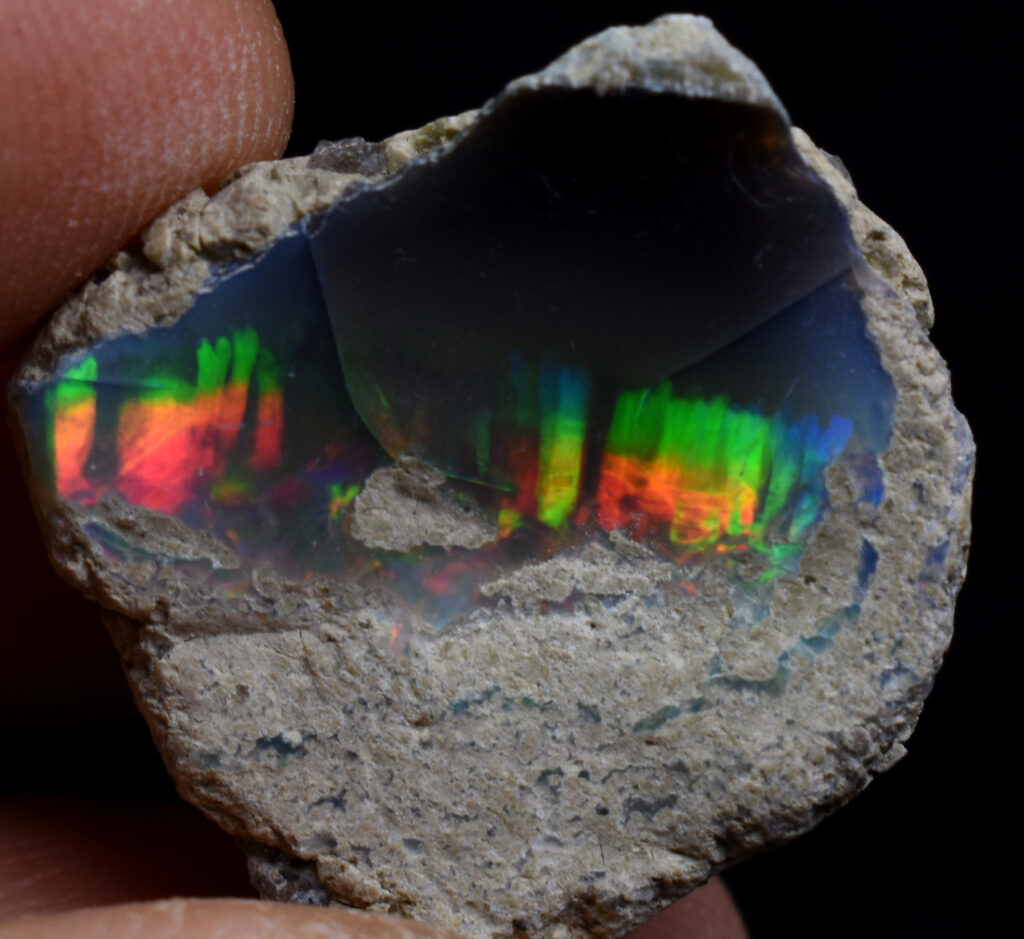
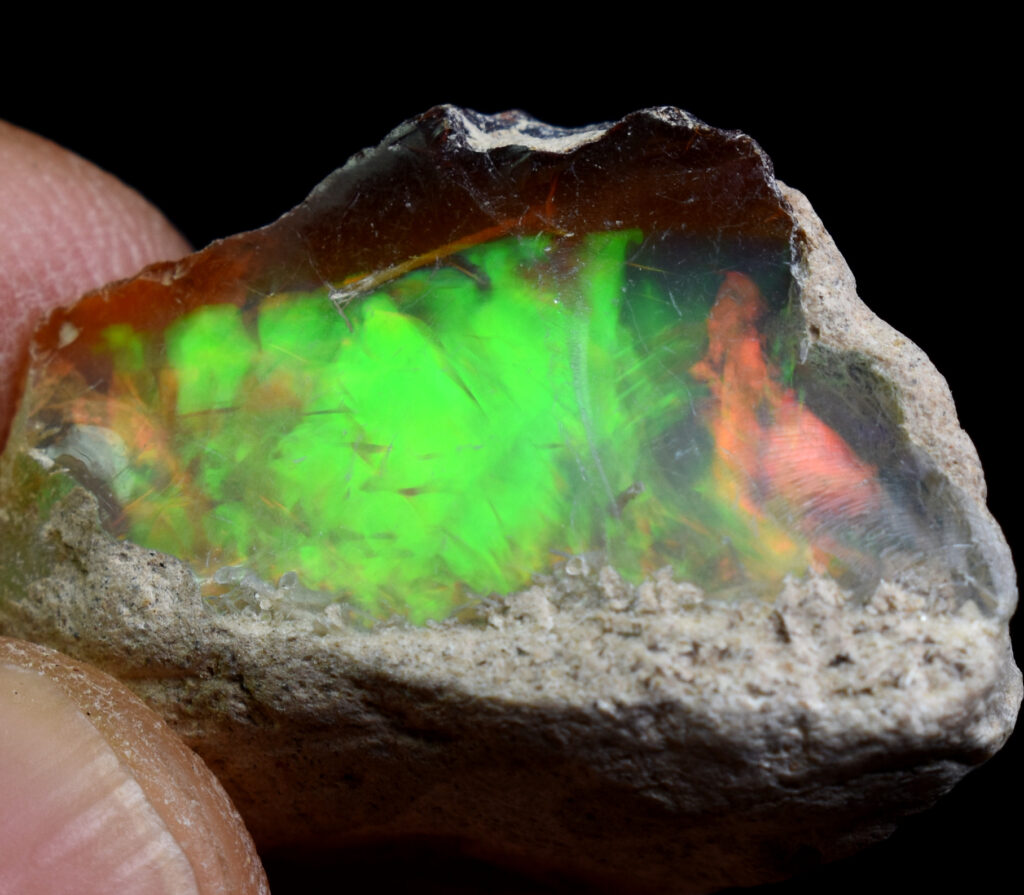
- Ethiopian Welo hydrophane opals: Are known for their vibrant play-of-colour and hydrophane nature (meaning they can absorb water). They come in a spectrum of body colours, from white and crystal to dark and black, often showcasing intricate patterns like honeycomb.
- Ethiopian Welo Non-hydrophane opals: Unlike hydrophane opals, they do not absorb water. While they generally don’t need to be kept submerged, it’s best to protect them from extreme heat or very rapid changes in temperature and humidity, which can sometimes lead to cracking over a long period. But it won’t affect them to show their stunning play-of-colour
- At Calder Crystals, we stock many stunning Ethiopian Opal specimens, please check the link for details Ethiopian Opals
- Peruvian Opals: Found in the Andes Mountains, Peruvian opals are typically common opals without play-of-colour. They are cherished for their beautiful opaque to semi-opaque pastel colours, especially the serene blue and pink varieties, often referred to as “Andean Opal.” Use the link Peruvian Opals to see all the Peruvian Opals at Calder Crystals
- Other Notable Global Sources: Opals are also found in various other countries, including Brazil (producing stable crystal opals), Honduras (known for volcanic opals, including black matrix opal), the USA (Virgin Valley, Nevada, and Oregon for Hyalite opal, Utah for Tiffany opal), Slovakia, Indonesia, Namibia and Tanzania (Prase opal).
My personal Favourite opal must be Hyalite Opal (Water Opal): A fascinating type of common opal primarily found in volcanic regions, notably the USA (such as New Mexico and Oregon), Mexico, and Germany. Hyalite opal often appears colourless, glassy, and forms in botryoidal (grape-like) or stalactitic habits. Its most captivating feature is its strong fluorescence under ultraviolet (UV) light, commonly glowing a vivid, ethereal green. This reaction is due to the presence of trace amounts of uranium, which is naturally occurring and harmless. We have Hyalite Opals from Mexico and Namibia at Calder Crystals (use the link for details Hyalite Opals) . The Namibian Hyalite opals we stock hold a truly special place in our collection. Many of these unique pieces are found growing alongside striking black / schorl tourmaline or beautiful smoky quartz, creating fascinating natural combinations. What makes them even more extraordinary is our direct connection to their source: we personally acquired these stunning specimens from local, friendly miners during our recent mineral tour in Namibia. This ensures not only the authenticity of each piece but also supports the communities where these geological wonders are discovered.
Whether you’re a seasoned collector or new to the world of gemstones, the global diversity of opals offers an endless source of fascination. At Calder Crystals, we invite you to explore our selection and find the perfect piece that resonates with your unique spirit.
Keep Exploring the World of Minerals!
We hope you’ve enjoyed diving into the unique properties of this mineral. Learning about crystals and minerals is a fascinating journey, and we’re committed to empowering you with knowledge.
That’s why we publish a new blog post every week, exploring the unique characteristics, incredible stories, and diverse uses behind different crystals and minerals.
Connect with us on social media to stay updated:
- Instagram: @CalderCrystals
- Facebook: @CalderCrystals
- TikTok: @calder_crystals
- YouTube: @caldercrystals5204
Looking to stock or collect our beautiful crystals and minerals? We also offer a dedicated wholesale service! Visit our trade website – trade.caldercrystals.com to explore our extensive collection at competitive prices!
We’re excited to continue sharing the amazing world of minerals with you!